



For years, the United States military has quietly developed contingency plans for possible ground operations in Iran, according to a former senior commander. The remarks come amid renewed debate in Washington over whether to expand military involvement in the Middle East, as tensions with Tehran continue to shape regional security and global energy markets.
Long-Standing Strategic Planning
Retired General Frank McKenzie, who previously led U.S. Central Command (Centcom), said that planning for limited ground incursions has been underway for years. Speaking to Margaret Brennan on Face the Nation, McKenzie outlined scenarios focused primarily on Iran’s southern coastline.
These plans, he explained, centre on targeted raids rather than prolonged occupation. “A raid is an operation with a planned withdrawal,” McKenzie said, describing missions that would involve seizing strategic islands or small military installations before withdrawing forces.
However, he noted that in some cases, holding territory temporarily could serve broader strategic goals.
Strategic Targets and Economic Pressure
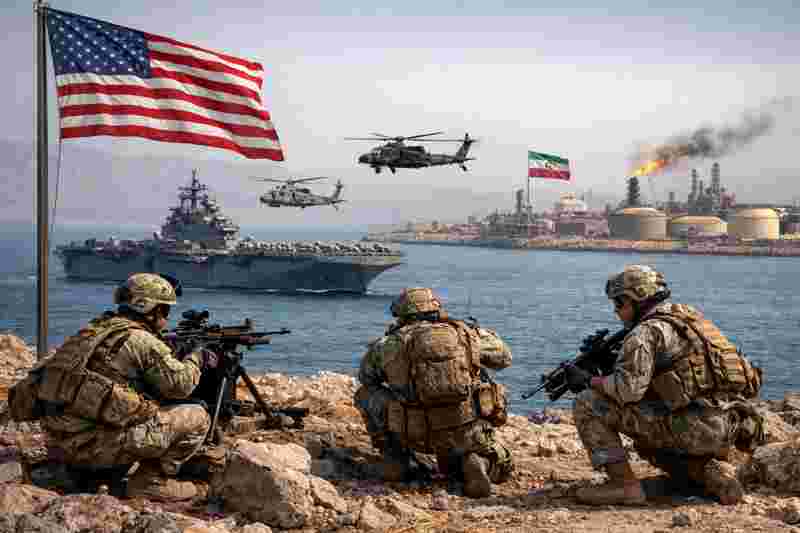
Among the potential objectives discussed is Kharg Island, a critical hub for Iran’s oil exports. Control of the island could significantly disrupt Iran’s energy sector, which remains a cornerstone of its economy and a key factor in global oil supply.
McKenzie argued that such an operation could deliver both military and diplomatic advantages. Capturing strategic locations without destroying infrastructure would preserve their value while increasing leverage in negotiations.
He suggested that the symbolic impact would also be considerable. A successful seizure of Iranian territory, even temporarily, would represent a major blow to Tehran’s regional standing and could shift the balance in ongoing geopolitical disputes.
Pentagon Preparing Contingency Plans
According to reporting by The Washington Post, the U.S. Department of Defense has recently reviewed plans for ground operations in Iran that could last several weeks. These scenarios reportedly involve a combination of special operations forces and conventional infantry units conducting targeted raids.
At the same time, the U.S. military has increased its presence in the region. An Amphibious Ready Group, including the USS Tripoli and roughly 3,500 sailors and Marines, has arrived in the Centcom area of responsibility. The deployment includes aircraft, amphibious assault capabilities, and tactical support systems designed for rapid-response missions.
Despite the build-up, officials in Washington have emphasised that the deployment does not necessarily indicate a decision to launch ground operations.
Strategic Goals Beyond Ground Combat
McKenzie stressed that a military campaign involving Iran would not necessarily require a large-scale ground invasion to achieve its objectives. Instead, he outlined more limited and realistic goals.
These include ensuring the continued operation of the Strait of Hormuz—a vital maritime route through which a significant share of the world’s oil supply passes—as well as securing agreements on Iran’s ballistic missile and nuclear programmes.
“I believe all of those things are actually within our grasp,” McKenzie said, suggesting that sustained military pressure could eventually compel Iran to negotiate.
Public Opinion Remains Divided
While policymakers weigh their options, public sentiment in the United States appears cautious. A recent poll conducted by CBS News and YouGov found that 60 percent of Americans oppose the conflict with Iran, while 40 percent support it.
The findings reflect broader concerns about the risks of escalation in the Middle East, including potential disruptions to global energy markets and the possibility of a prolonged military engagement.
Conclusion
The comments from former Centcom commander Frank McKenzie highlight that U.S. planning for potential operations in Iran is neither new nor improvised. While ground raids remain only one option among many, their strategic implications—both militarily and economically—underscore the complexity of any future conflict. As Washington continues to assess its approach, the balance between military action, diplomacy, and public opinion will remain a defining factor.

Charles Dickens is a contributor to Highlands Today, covering news, politics, business, technology, sport, entertainment, and lifestyle. He focuses on clear, accurate reporting and useful information that helps readers stay informed about current affairs and developments affecting their communities. His work highlights relevant stories, emerging trends, and important issues, presenting them in a balanced, accessible, and reader-friendly manner.