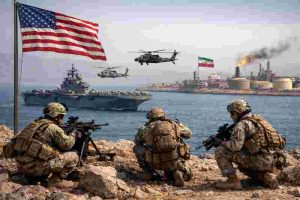




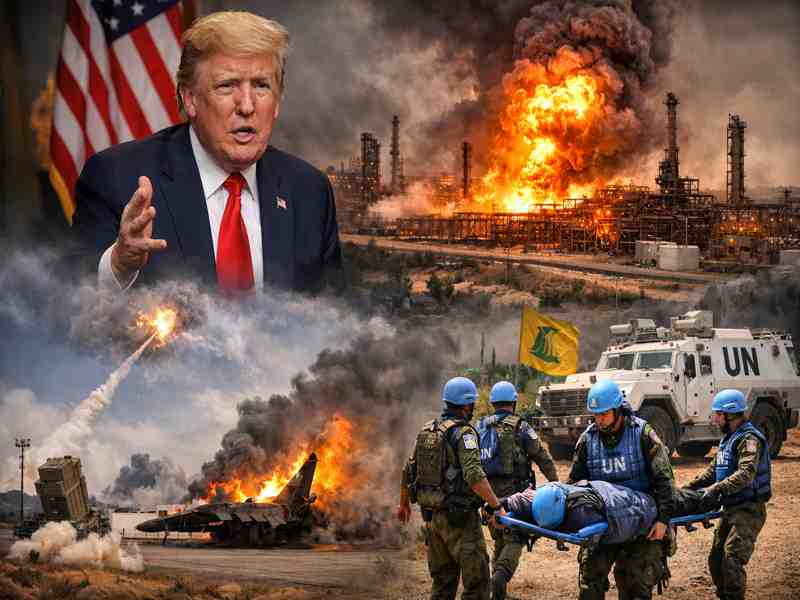
A sharp escalation in the Middle East has raised fears of a broader regional conflict, as military strikes, drone attacks, and political rhetoric signal deepening divisions between Iran, the United States, Israel, and their allies. Recent developments underline the fragile security environment across the Gulf and neighbouring regions, with growing international calls for de-escalation.
Trump Signals Hardline Stance on Iran’s Oil
US President Donald Trump has stated in a recent interview that he would like to “take the oil in Iran,” a remark likely to heighten tensions with Tehran. Iranian officials have accused Washington of preparing for a potential ground offensive, despite ongoing public messaging from the US favouring a negotiated resolution.
The comments reflect a broader strategic focus on energy resources in the region, which remains central to global oil markets and geopolitical stability.
Attacks Across the Gulf and Beyond
Kuwait reported that an Indian national was killed following an Iranian strike on a power generation and desalination facility. The incident highlights the vulnerability of critical infrastructure in Gulf countries, where desalination plants are essential for freshwater supply.
Elsewhere in the region, several Gulf states confirmed they had intercepted incoming drones and missiles, suggesting a coordinated wave of attacks or heightened military readiness.
Strikes Hit Iran and Israel
Joint US-Israeli strikes targeted a petrochemical facility in Tabriz, a major industrial city in northwestern Iran. In addition, power outages were reported in parts of Tehran, indicating possible damage to energy infrastructure.
In response, Iranian forces launched attacks on an industrial zone in southern Israel. The strike caused a fire and raised concerns over a potential chemical leak, although the extent of the damage remains unclear.
Israel also reported intercepting two drones launched from Yemen by Houthi forces, further illustrating the multi-front nature of the conflict.
UN Peacekeeper Killed in Lebanon
The United Nations confirmed the death of a peacekeeper following an attack in southern Lebanon. The incident underscores the risks faced by international personnel operating in volatile border regions, particularly along the Israel-Lebanon frontier, where tensions have periodically flared.
Regional Diplomacy Seeks De-escalation
Amid rising hostilities, foreign ministers from Pakistan, Egypt, Türkiye, and Saudi Arabia convened in Islamabad. The group expressed a مشتر commitment to reducing tensions and finding diplomatic pathways to end the conflict involving the United States and Israel.
Such diplomatic efforts reflect growing concern among regional powers about the potential for a wider war that could destabilise the broader Middle East.
Syria Reports Drone Attack Near Iraqi Border
According to Syria’s state news agency SANA, the Syrian army detected a large-scale drone attack targeting multiple military positions near the Iraqi border early in the morning.
The military reported intercepting most of the drones, though it did not disclose details about any damage caused by those that penetrated air defences.
Rockets Strike Iraqi Air Base
In Iraq, rockets struck the Mohamad Alaa air base, located adjacent to Baghdad International Airport. The country’s Defence Ministry confirmed that one aircraft was destroyed, but no casualties were reported.
Earlier reports indicated that air defence systems failed to intercept the incoming rockets, which hit an Iraqi special forces transport plane and set it on fire. Authorities are currently investigating the source of the हमला.
Missile Alert in Northern Israel
Israel issued an early warning alert in its northern regions after detecting a missile launch from Iran. The alert system is part of Israel’s layered missile defence network, designed to provide civilians with advance notice of incoming threats.
الفلسطيني Land Day Highlights Historical Grievances
The escalation coincides with Land Day, observed annually by Palestinians on March 30. The day commemorates events in 1976, when six unarmed الفلسطيني protesters were killed by Israeli forces during demonstrations against land confiscations in the Galilee.
At the time, Israeli authorities had announced plans to seize approximately 2,000 hectares (around 4,942 acres) of land belonging to Palestinian citizens. The protests were centred in towns such as Sakhnin, Arrabeh, and Deir Hanna.
The الأراضي in question roughly equate to the size of several thousand football pitches or a مساحة comparable to lower Manhattan up to Central Park in New York City.
Analysts Warn of Prolonged Conflict
Middle East analyst Mohamad Elmasry has suggested that Israel is preparing for an extended period of conflict across multiple fronts. Speaking in a media interview, he pointed to Israel’s record national budget of $271 billion as evidence of long-term military planning.
The United States currently provides Israel with approximately $3.8 billion in annual military aid, a figure that typically increases during wartime.
Elmasry noted shifting attitudes within the United States, where public opinion is becoming more critical of both Israel and US foreign policy in the region. He argued that Israeli policymakers may be anticipating changes in American support.
According to his assessment, Israel does not view the current situation as nearing resolution, but rather as part of a broader and potentially prolonged series of conflicts involving Syria, Lebanon, Palestinian territories, and Iran.
Conclusion
The latest developments highlight a rapidly intensifying conflict with significant regional and global implications. As military actions expand across multiple देशों and diplomatic efforts struggle to gain traction, the risk of a wider الحرب continues to grow. The coming days are likely to prove critical in determining whether escalation can be contained or if the region moves closer to sustained युद्ध.

Charles Dickens is a contributor to Highlands Today, covering news, politics, business, technology, sport, entertainment, and lifestyle. He focuses on clear, accurate reporting and useful information that helps readers stay informed about current affairs and developments affecting their communities. His work highlights relevant stories, emerging trends, and important issues, presenting them in a balanced, accessible, and reader-friendly manner.