


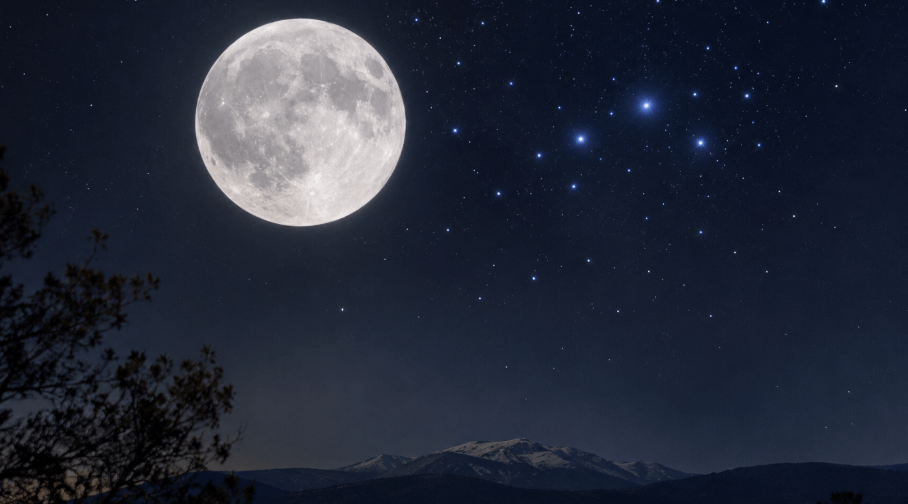
Skywatchers across the United States can look forward to several notable celestial events this week, highlighted by November’s full Beaver Supermoon passing close to the Pleiades star cluster, commonly known as the “Seven Sisters.”
The brightest spectacle arrives Tuesday, November 24, when the full moon appears slightly larger and brighter than usual while passing just 0.9 degrees north of the famous star cluster in the constellation Taurus.
Other astronomical highlights between November 23 and 29 include a close encounter between Mars and Regulus, Uranus reaching opposition, and Venus shining at its greatest brightness in the early morning sky.
November 2026 Night Sky: Key Celestial Events to Watch
Monday, November 23: Moon Approaches the Seven Sisters
Shortly after sunset Monday, observers should look toward the eastern sky to see an almost full moon approaching the Pleiades star cluster.
Located in the constellation Taurus, the Pleiades is one of the most recognizable star clusters visible from Earth.
Although the moon’s intense glow may obscure some of the cluster’s fainter stars, its brightest members should remain visible nearby.
Tuesday, November 24: Full Beaver Supermoon Rises
The week’s main astronomical event takes place Tuesday evening as November’s Beaver Supermoon rises in the eastern sky.
The full moon occurs close to lunar perigee, the point in the moon’s orbit when it is nearest Earth. As a result, it will appear slightly larger and brighter than an average full moon.
The moon will also pass approximately 0.9 degrees north of the Pleiades, creating a striking celestial pairing.
For the best viewing experience, observers should find an unobstructed eastern horizon around their local moonrise time.
Wednesday, November 25: Mars Passes Close to Regulus
Early Wednesday morning, Mars will appear near Regulus, the brightest star in the constellation Leo.
About an hour before sunrise, observers facing east can spot the reddish planet alongside the bluish-white star.
The contrasting colors should make the pairing particularly appealing to skywatchers.
Jupiter will also be visible nearby, shining considerably brighter than either Mars or Regulus.
Meanwhile, Uranus reaches opposition Wednesday evening. This alignment occurs when Earth passes between the planet and the sun, placing Uranus opposite the sun in Earth’s sky.
Observers will need powerful binoculars or a telescope to locate the distant planet.
Friday, November 27: Venus Reaches Greatest Brightness
Venus will dominate the predawn sky Friday as it reaches its greatest brightness during its current morning appearance.
Approximately 45 minutes before sunrise, observers should face east-southeast to locate the brilliant planet.
Often called the “Morning Star,” Venus is exceptionally bright because of its relative proximity to Earth and its highly reflective atmosphere, which is permanently covered by thick clouds.
Its brightness makes it one of the easiest celestial objects to identify without specialized equipment.
What Makes November’s Beaver Moon a Supermoon?
A supermoon occurs when a full moon takes place near perigee, the closest point to Earth in its elliptical orbit.
Because the moon’s distance from Earth changes throughout the month, some full moons appear larger and brighter than others.
A supermoon can appear approximately 7% to 10% larger and around 15% brighter than a typical full moon.
However, these differences are generally subtle without a direct comparison.
One of the most dramatic visual effects occurs when the moon rises near the horizon.
At that position, the moon often appears unusually large compared with buildings, trees and other landscape features.
This phenomenon, known as the “moon illusion,” is caused by how the human brain interprets visual cues rather than an actual increase in the moon’s apparent size.
Winter Constellations Begin to Dominate the November Sky
Late November also marks an excellent opportunity for American skywatchers to observe some of the Northern Hemisphere’s most familiar winter constellations.
Orion becomes increasingly prominent in the southeastern evening sky, with Taurus positioned above it and Gemini rising nearby.
Below Orion, Sirius, the brightest star in Earth’s night sky, shines prominently as it climbs above the horizon.
Its distinctive twinkling becomes especially noticeable when viewed through thicker layers of Earth’s atmosphere near the horizon.
The Winter Hexagon Offers Another Stargazing Highlight
Several bright stars across the winter constellations form a large celestial pattern known as the Winter Hexagon.
The formation stretches across prominent constellations including Orion, Taurus, Auriga, Gemini and Canis Major.
Because many of its stars are exceptionally bright, the pattern can be identified without a telescope under reasonably clear conditions.
For better visibility, observers should choose locations away from strong artificial lighting and allow their eyes time to adjust to the darkness.
A Busy Week Ahead for Stargazers Across the United States
From the Beaver Supermoon’s close encounter with the Seven Sisters to the brilliant appearance of Venus before sunrise, the final full week of November offers several opportunities to explore the night sky.
Clear weather and an unobstructed view of the horizon will help observers enjoy these events, most of which can be seen without specialized astronomical equipment.

Charles Dickens is a contributor to Highlands Today, covering news, politics, business, technology, sport, entertainment, and lifestyle. He focuses on clear, accurate reporting and useful information that helps readers stay informed about current affairs and developments affecting their communities. His work highlights relevant stories, emerging trends, and important issues, presenting them in a balanced, accessible, and reader-friendly manner.