




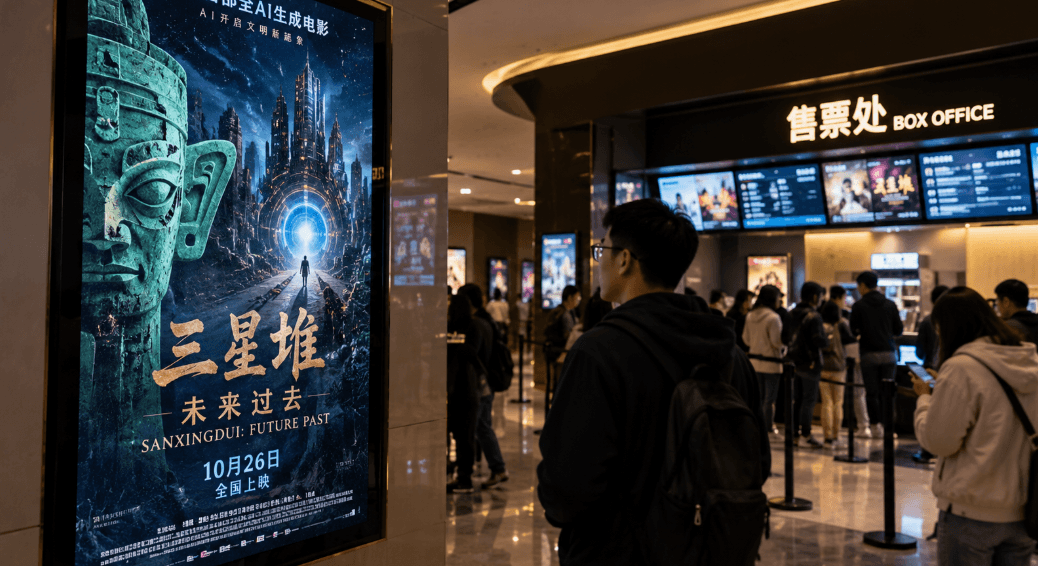
China’s first widely released feature-length movie created entirely with artificial intelligence has struggled to attract moviegoers, raising questions about whether AI-generated filmmaking is ready for mainstream audiences. The science-fiction thriller Sanxingdui: Future Past marks a significant technological milestone, but its disappointing box office performance highlights the challenges facing AI-produced entertainment.
AI-Generated Film Earns Just $198,000 in China
Released in Chinese theaters in October 2026, Sanxingdui: Future Past generated an estimated $198,000 in ticket sales during its initial release period, according to Agence France-Presse (AFP).
The film reportedly had a production budget of 10 million yuan, approximately $1.5 million. Early ticket revenue amounted to roughly 12% of that budget, indicating a difficult commercial start.
Despite the weak financial performance, the movie represents an important development in the entertainment industry’s growing use of generative AI.
The production received more than 10,000 screenings on its opening day, making it one of the first feature-length AI-generated movies to receive a substantial theatrical rollout in a major international film market.
Although other countries have previously screened AI-created feature films in limited releases, Sanxingdui: Future Past offers an early opportunity to evaluate the technology’s commercial potential through publicly reported box office results.
Bona Film Group Calls AI Movie an Important Experiment
The movie was produced by China’s Bona Film Group, which has positioned the project as an experiment in AI-driven filmmaking rather than solely a commercial venture.
According to AFP, Bona Film Group CEO Jiang Defu discussed the significance of the production in comments to Chinese film publication Yuli.
“We are the first to try it, the first to get a theatrical release permit and the first to be tested by the audience. I think that is not easy at all.”
His remarks underscore the technological and regulatory challenges associated with bringing a fully AI-generated feature film to theaters.
Audience Reactions Highlight Quality Concerns
While the film’s release represents progress for AI filmmaking, early audience reactions suggest that the technology still faces significant creative limitations.
One moviegoer interviewed by AFP expressed disappointment with the movie’s overall quality.
“In terms of quality, compared with human production, it still falls short.”
The response reflects broader concerns about whether generative AI can consistently deliver the visual quality, storytelling and emotional engagement audiences expect from traditionally produced films.
For movie studios, the challenge extends beyond creating feature-length content using artificial intelligence. AI-generated productions must also compete with established filmmaking techniques and meet audience expectations.
AI Filmmaking Faces Similar Challenges in the United States
The disappointing performance of Sanxingdui: Future Past comes as AI-generated entertainment faces scrutiny in the United States.
An AI-produced adaptation of Homer’s The Odyssey, associated with Elon Musk, also drew negative viewer reactions following the release of its first chapter.
The two projects illustrate how technological innovation does not necessarily translate into audience enthusiasm.
Hollywood studios and independent filmmakers are increasingly exploring generative AI for visual effects, animation, concept development and other production activities.
However, producing an entire feature-length movie using AI presents additional challenges, particularly when maintaining consistent visual quality and compelling storytelling across a full theatrical release.
The commercial reception of these early projects could influence how aggressively entertainment companies pursue AI-generated feature films.
China’s AI Microdrama Industry Shows Rapid Growth
Despite the theatrical setback, artificial intelligence is already playing a major role in China’s rapidly expanding digital entertainment industry.
According to Fortune, approximately 95% of China’s short-form online films, commonly known as microdramas, are AI-generated.
These productions are typically designed for digital platforms and mobile viewing, where shorter running times and rapid content production can make AI-based workflows particularly attractive.
Short-Form Success May Shape Future Feature Films
The widespread adoption of AI in microdramas suggests that the technology has already established a significant presence in certain entertainment formats.
Feature-length theatrical productions, however, require audiences to remain engaged for substantially longer periods and compete directly with movies created through conventional production methods.
As AI video-generation tools improve, filmmakers may gain greater control over character consistency, visual presentation and narrative development.
Those advances could eventually help AI-produced movies overcome some of the limitations identified by early audiences.
What the Box Office Results Mean for AI-Generated Movies
The commercial disappointment of Sanxingdui: Future Past does not necessarily indicate that audiences will reject AI-generated feature films in the long term.
Instead, its release provides an early benchmark for an emerging filmmaking approach that remains under development.
The movie’s wide theatrical distribution also demonstrates that AI-generated productions are beginning to move beyond experimental screenings and online platforms into established cinema markets.
For Hollywood and international film studios, the results offer a reminder that production technology alone is unlikely to determine a movie’s commercial success.
Ultimately, Sanxingdui: Future Past may be remembered less for its box office earnings than for helping establish a new stage in AI filmmaking. Although the first major commercial test has produced disappointing results, continued technological advances and the growing popularity of AI-generated short-form entertainment suggest that a successful feature-length AI movie remains a realistic possibility.

Charles Dickens is a contributor to Highlands Today, covering news, politics, business, technology, sport, entertainment, and lifestyle. He focuses on clear, accurate reporting and useful information that helps readers stay informed about current affairs and developments affecting their communities. His work highlights relevant stories, emerging trends, and important issues, presenting them in a balanced, accessible, and reader-friendly manner.