



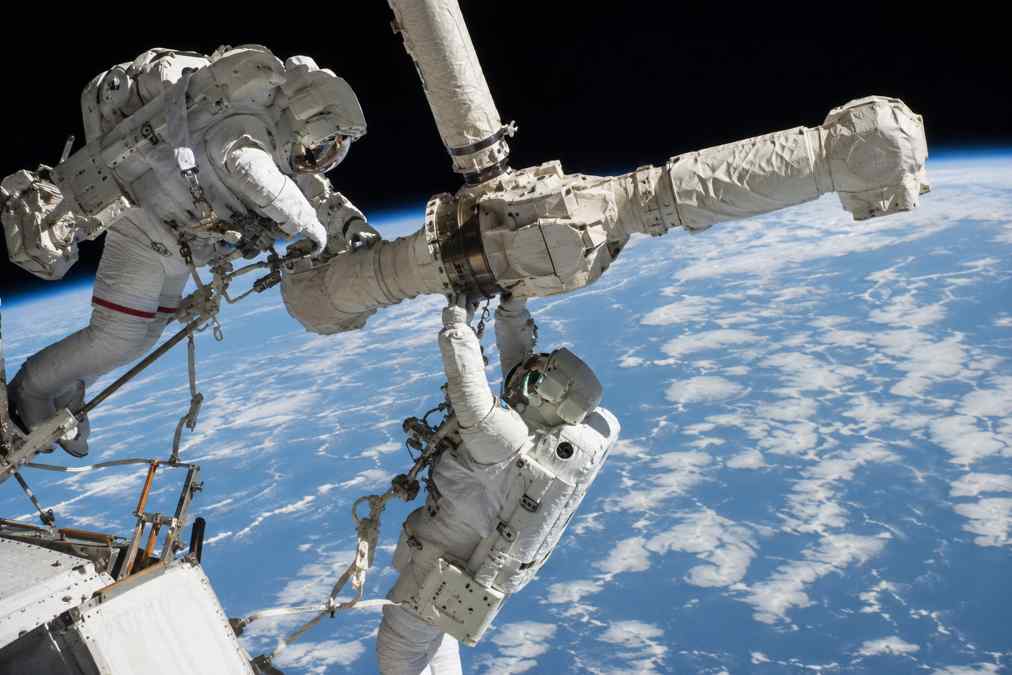
NASA astronauts aboard the International Space Station (ISS) completed a complex repair mission Tuesday, replacing a failed joint in the station’s robotic arm during a spacewalk that lasted more than seven hours. The operation restored full functionality to Canadarm2, a critical piece of equipment used for cargo handling, maintenance work, and supporting astronauts during spacewalks.
Astronauts Complete Delicate Repair on Canadarm2
The repair focused on a malfunctioning 200-pound wrist joint near the end of Canadarm2, the Canadian-built robotic arm that stretches approximately 58 feet across the exterior of the orbiting laboratory.
Flight controllers at NASA’s Johnson Space Center in Houston first detected the problem on May 27 when telemetry data showed one of the arm’s seven joints was drawing unusually high electrical current and failing to move correctly.
Following an extensive review, NASA engineers and specialists from the Canadian Space Agency determined that the joint had failed and needed replacement. Fortunately, spare components had been stored outside the station specifically for situations like this.
“Systems like Canadarm2 were designed from the beginning with replaceable components and were planned with maintenance in mind,” ISS Operations and Integration Manager Bill Spetch said. “This is no exception.”
Spacewalk Lasts More Than Seven Hours
NASA astronauts Jessica Meir and Chris Williams began the spacewalk at 8:20 a.m. Eastern Time after switching their spacesuits to battery power inside the station’s Quest airlock.
The excursion marked the third ISS spacewalk of the year and the 280th spacewalk dedicated to station assembly, maintenance, and upgrades.
Working outside the station, the astronauts first positioned foot restraints and prepared the replacement hardware. They then removed the arm’s “hand,” known as the Latching End Effector (LEE), along with two functioning joints connected to the failed component.
The combined assembly, weighing about 900 pounds, was temporarily secured to a nearby storage location, allowing the crew to access the damaged wrist joint.
Replacement Joint Installed Successfully
About four and a half hours into the mission, the astronauts successfully removed the failed joint and installed the spare replacement.
Flight Director Fiona Antkowiak outlined the operation before the repair was completed.
“We’ll remove the failed joint five, replace it with the spare joint and then once that’s back on the arm, our last major task will be to get that LEE cluster that we temporarily stowed and put it back onto the robotic arm so that we have a fully assembled arm at the end of the spacewalk,” Antkowiak said.
Roughly an hour later, Meir and Williams reattached the LEE assembly, restoring the arm to its original configuration.
Mission Control Confirms Successful Repair
After the reassembly was complete, flight controllers powered up Canadarm2 and conducted tests to verify electrical and data connections through the newly installed joint.
NASA commentator Sandra Jones confirmed the repair had achieved its objective.
“Today we did hear good confirmation that … Canadarm2 has two good strings of power and data to the arm,” Jones said. “So today’s wrist surgery was successful.”
Canadian astronaut Jenni Gibbons, supporting operations from mission control, congratulated the crew near the end of the mission.
“That is a good install, you guys. I know that was tough. Wonderful work,” she said.
With the repair complete, the astronauts gathered their tools and returned to the Quest airlock to conclude the seven-hour, 20-minute spacewalk.
Failed Component Will Return to Earth
Williams also brought the defective joint back inside the station. NASA plans to return the hardware to Earth for inspection and repairs.
Once refurbished, the component is expected to be launched back to orbit alongside another spare unit for future maintenance needs.
The ability to replace and repair major station hardware has long been a key part of the ISS design strategy, helping extend the lifespan of critical systems operating hundreds of miles above Earth.
Why Canadarm2 Remains Essential
Canadarm2 plays a central role in daily station operations. The robotic arm captures visiting cargo spacecraft, including Northrop Grumman’s Cygnus resupply vehicles, and helps position equipment, modules, and astronauts during maintenance activities.
Although NASA plans to retire the International Space Station by the end of 2030, agency officials say maintaining the robotic arm remains a priority.
“There’s not a time where we say hey, we’re just done repairing the arm,” Spetch said. “Overall, the arm is critical for station operations and continued maintenance of it throughout to the end of life.”
Looking Ahead
The successful replacement of Canadarm2’s failed wrist joint demonstrates the International Space Station’s ability to conduct major repairs in orbit using spare components and astronaut expertise. With the robotic arm fully restored, the station remains equipped to support cargo operations, maintenance tasks, and scientific missions through the remainder of its operational life.

Charles Dickens is a contributor to Highlands Today, covering news, politics, business, technology, sport, entertainment, and lifestyle. He focuses on clear, accurate reporting and useful information that helps readers stay informed about current affairs and developments affecting their communities. His work highlights relevant stories, emerging trends, and important issues, presenting them in a balanced, accessible, and reader-friendly manner.