



India’s education authorities are facing mounting scrutiny after a school textbook discussing judicial corruption was banned by the country’s highest court, prompting intervention from Prime Minister Narendra Modi and raising broader questions about curriculum oversight and institutional respect. The dispute highlights tensions between transparency in civic education and maintaining public confidence in the justice system.
Supreme Court Bans NCERT Textbook, Orders Investigation
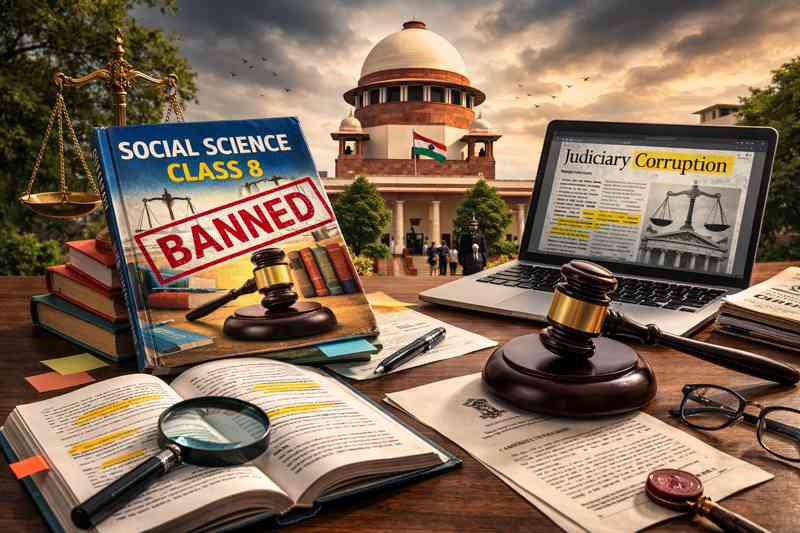
India’s Supreme Court has ordered an immediate ban on a National Council of Educational Research and Training (NCERT) Class 8 social science textbook, both domestically and internationally, and directed authorities to seize all copies.
The bench, led by Chief Justice Surya Kant, also prohibited sharing the book online, either in full or in part. Notices were issued to senior education officials, including the Secretary of School Education and the NCERT Director, demanding an explanation.
The court signalled strong concern over references to “corruption in the judiciary”, warning that it would pursue accountability.
“We would like to have a deeper probe. We need to find out who is responsible,” the court said, adding that the matter would not be closed without determining responsibility.
Officials have also been ordered to produce detailed records of meetings, approval processes, and the names and qualifications of those involved in drafting and approving the chapter.
Prime Minister and Education Minister Respond
Prime Minister Narendra Modi has expressed dissatisfaction with how the material was approved, according to government sources.
“Who is looking after all this,” he reportedly said while overseas, signalling concern at the highest level of government.
Education Minister Dharmendra Pradhan publicly apologised and emphasised the government’s respect for the judiciary.
“We hold the judiciary in the highest regard. There was absolutely no intention to disrespect the judiciary,” he told reporters.
He said the government would comply fully with the Supreme Court’s decision and described the situation as deeply regrettable.
The NCERT itself acknowledged the controversy, calling the inclusion of the material an “error of judgement” and issuing an apology.
What the Textbook Chapter Included
The revised chapter, titled The Role of the Judiciary in Our Society, marked a shift from previous editions by discussing not only how courts function but also the challenges they face.
These included case backlogs and corruption.
According to figures cited in the textbook:
- Around 81,000 cases are pending in the Supreme Court
- More than 6.2 million cases are awaiting resolution in High Courts
- Approximately 47 million cases remain unresolved in district and subordinate courts
The chapter explained that judges are bound by strict codes of conduct covering both professional and personal behaviour.
It also outlined mechanisms designed to ensure accountability, including formal complaints processes through government monitoring systems.
The text noted that authorities are working to improve transparency, including through the use of technology and faster disciplinary action.
It also quoted former Chief Justice BR Gavai, who warned in 2025 that corruption and misconduct within the judiciary can undermine public confidence.
Wider Debate About Education and Public Trust
The case has triggered a wider debate in India about how civic institutions should be taught in schools.
Supporters of the textbook content argue that acknowledging challenges such as case delays and corruption is part of educating students about real-world governance.
Critics, including senior judicial figures, contend that highlighting such issues in school materials risks damaging trust in democratic institutions.
The situation has parallels with debates in other democracies, including New Zealand, where curriculum content about government, Treaty history, and public institutions can generate political and public discussion about balance and accuracy.
Conclusion
The textbook ban and investigation reflect the sensitivity surrounding judicial integrity in India and the political importance of maintaining institutional credibility. With the Supreme Court demanding answers and the government promising accountability, the outcome could influence how civic education is developed and approved in the future.

Charles Dickens is a contributor to Highlands Today, covering news, politics, business, technology, sport, entertainment, and lifestyle. He focuses on clear, accurate reporting and useful information that helps readers stay informed about current affairs and developments affecting their communities. His work highlights relevant stories, emerging trends, and important issues, presenting them in a balanced, accessible, and reader-friendly manner.