




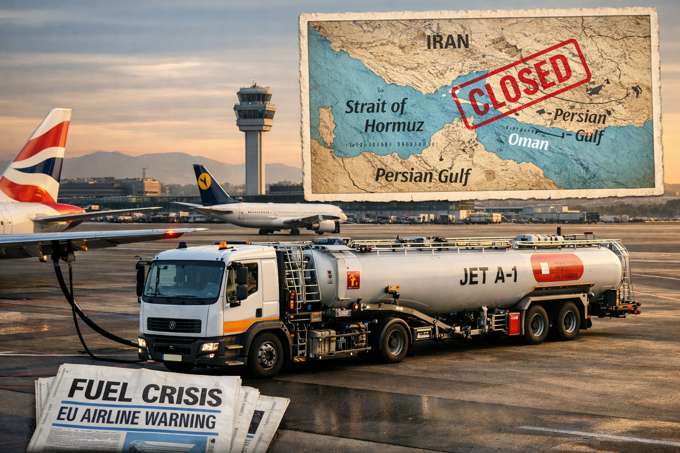
European airports could begin facing significant jet fuel shortages within three weeks if the Strait of Hormuz remains closed, according to the continent’s leading airport trade association, raising concerns over disruption to summer travel and wider economic impacts across the region.
The warning comes as aviation operators across Europe grapple with surging fuel prices and growing uncertainty over supplies from the Gulf, a key source of imported jet fuel for the European market.
European Airports Warn of Looming Fuel Shortages
Airports Council International Europe (ACI Europe) said airports across the continent are increasingly concerned about the availability of jet fuel, particularly ahead of the busy summer holiday season.
The organisation warned that Europe relies heavily on imports from the Persian Gulf, which account for around half of the bloc’s jet fuel supply.
In a letter to European Commissioners responsible for energy and tourism, ACI Europe Director-General Olivier Jankovec said a prolonged closure of the Strait of Hormuz would create severe pressure on the aviation sector.
“A supply crunch would severely disrupt airport operations and air connectivity – with the risk of harsh economic impacts for the communities affected, and for Europe,” he wrote.
He added that unless shipping through the strait resumes in a “significant and stable” way within the next three weeks, “systemic jet fuel shortage is set to become a reality for the EU”.
Smaller Regional Airports Most Exposed
ACI Europe said smaller and regional airports are particularly vulnerable to supply disruption.
According to the trade body, airports handling fewer than one million passengers annually are already under financial strain, even before accounting for the impact of fuel shortages.
Jankovec warned that further pressure on such airports could weaken transport links for remote and regional communities across Europe, undermining economic cohesion and local connectivity.
Jet Fuel Prices Reach Record High
Jet fuel prices in north-west Europe have risen sharply since the outbreak of conflict involving Iran.
Benchmark European jet fuel prices reached a record high of $1,838 (£1,387) per tonne last week, up from $831 per tonne before the war began.
Several airlines around the world have already reduced flight schedules and increased passenger charges in response to higher fuel costs and concerns over supply availability.
ACI Europe Calls for EU Intervention
ACI Europe has urged the European Union to take coordinated action, arguing that market mechanisms alone will not be enough to manage the crisis.
The organisation criticised what it described as the absence of EU-wide monitoring of jet fuel production and availability.
Among its proposals, ACI Europe has called for:
Collective Purchasing of Jet Fuel
The trade body wants the EU to coordinate joint procurement efforts to secure supply across member states.
Temporary Relaxation of Import Rules
ACI Europe has also asked Brussels to temporarily ease restrictions and regulatory requirements affecting jet fuel imports in order to increase supply flexibility.
Greater Support for Sustainable Aviation Fuel
The group said the crisis should be used as an opportunity to accelerate investment in sustainable aviation fuel (SAF), arguing that long-term conventional jet fuel prices are likely to remain elevated.
Aviation’s Importance to the European Economy
Air travel remains a major pillar of the European economy, contributing an estimated €851 billion (£741 billion) to GDP each year and supporting around 14 million jobs, according to industry figures.
A prolonged disruption to fuel supplies could therefore have consequences well beyond the aviation sector, affecting tourism, trade and regional economies throughout Europe.
Outlook Remains Uncertain
With the peak summer travel period approaching, European airports and airlines are facing mounting pressure to secure fuel supplies and avoid widespread disruption.
Industry leaders warn that unless the Strait of Hormuz reopens soon, Europe’s aviation sector may be forced into difficult operational decisions that could affect passengers, airports and local economies alike.

Charles Dickens is a contributor to Highlands Today, covering news, politics, business, technology, sport, entertainment, and lifestyle. He focuses on clear, accurate reporting and useful information that helps readers stay informed about current affairs and developments affecting their communities. His work highlights relevant stories, emerging trends, and important issues, presenting them in a balanced, accessible, and reader-friendly manner.