



The Vera C. Rubin Observatory has officially begun one of the most ambitious astronomy projects ever undertaken, marking a major milestone for scientists seeking to better understand the universe. Over the next decade, the observatory will conduct a comprehensive survey of the night sky, collecting vast amounts of data that could transform research on galaxies, asteroids, dark matter, and the evolution of the cosmos.
Rubin Observatory Begins the Legacy Survey of Space and Time
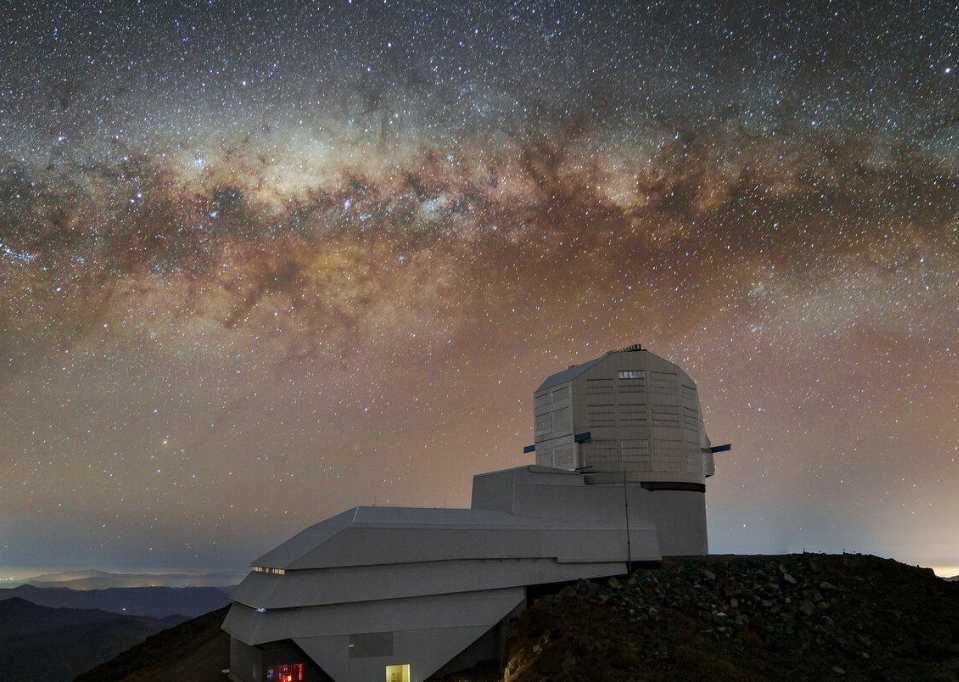
One year after releasing its first test images, the Vera C. Rubin Observatory has officially launched the Legacy Survey of Space and Time (LSST). Located atop Cerro Pachón in Chile, the observatory is designed to scan the visible and near-infrared sky every three days, creating an unprecedented time-lapse record of the universe.
The observatory’s early images offered a glimpse into its capabilities, capturing millions of distant galaxies and thousands of asteroids during only a few hours of test observations. Those initial results generated significant excitement within the scientific community, which has eagerly awaited the start of full-scale operations.
“It’s what I could only dream about 25 years ago,” said planetary scientist Mike Brown of the California Institute of Technology. “If you talk to 50 different astronomers, you would get 50 different answers about what they are looking forward to.”
A Powerful Telescope Built for the Next Decade
The Rubin Observatory is equipped with the 8.4-meter Simonyi Survey Telescope and the world’s largest digital camera. Weighing approximately three tons and featuring a resolution of 3,200 megapixels, the camera is capable of capturing extraordinary levels of detail across vast regions of the sky.
Every 30 seconds, the telescope will take a new image before repositioning to observe another section of the heavens. During its planned 10-year mission, Rubin is expected to observe each location in the survey area roughly 800 times.
Before launching the survey, researchers spent the past year testing the observatory’s systems, image quality, calibration accuracy, operational reliability, and data-processing performance. According to the project team, the decision to begin the LSST came after those benchmarks met the observatory’s scientific requirements.
“I’m excited because we are finally beginning to start answering the questions that Rubin set out to provide answers to,” said cosmologist Arun Kannawadi Jayaraman of Duke University. “And I’m nervous because, although we have been dealing with the immense amount of data Rubin Observatory has been generating during its Science Validation and Commissioning phase, it is now getting real.”
Tracking Supernovae and Cosmic Change
One of Rubin’s most important roles will be identifying transient events—astronomical phenomena that change over time, such as exploding stars known as supernovae.
The observatory’s data-processing center at the Department of Energy’s SLAC National Accelerator Laboratory in California will analyze incoming observations in near real time. When an object moves, brightens, fades, or otherwise changes, the system will automatically generate an alert for astronomers worldwide.
Researchers estimate the observatory could issue as many as 10 million alerts each night. Those notifications will help scientists rapidly coordinate follow-up observations using other telescopes and instruments.
“It is going to be hard for transients to hide from us,” Kannawadi said.
Mapping the Expansion of the Universe
Beyond detecting short-lived events, Rubin will gather critical information about the large-scale structure of the universe. By repeatedly observing billions of celestial objects, researchers hope to refine measurements of cosmic expansion and gain new insights into dark matter and dark energy, two of the biggest mysteries in modern astrophysics.
New Opportunities for Asteroid and Solar System Research
Planetary scientists are particularly enthusiastic about Rubin’s ability to discover and track objects within the solar system.
The observatory is expected to detect tens of thousands of near-Earth asteroids, improving scientists’ understanding of objects whose orbits occasionally bring them close to Earth or the Moon. Enhanced monitoring could also strengthen planetary defense efforts by identifying potentially hazardous asteroids earlier.
Researchers also anticipate finding additional interstellar objects—rare visitors that originate beyond our solar system. To date, only three such objects have been confirmed.
“The survey should revolutionize planetary science,” said Darryl Seligman of Michigan State University. “It’s really the beginning of an entirely new era in time-domain astronomy.”
Searching Beyond Neptune
Another major focus will be the discovery of trans-Neptunian objects, icy bodies that orbit beyond Neptune. These distant worlds include Pluto and many smaller objects that remain poorly understood.
Kat Volk of the Planetary Science Institute, a member of the LSST Solar System Science Collaboration, said she is particularly eager to identify more of these distant objects. Their orbital patterns can provide valuable clues about the formation and early evolution of the solar system, including how the outer planets developed over billions of years.
A New Era of Astronomical Discovery
With the start of the Legacy Survey of Space and Time, the Vera C. Rubin Observatory is entering a decade-long mission that could reshape multiple fields of astronomy. By repeatedly surveying the sky and generating an unprecedented stream of observations, the facility is expected to reveal new celestial phenomena, uncover previously unknown objects, and provide researchers with one of the most detailed records of the universe ever assembled.

Charles Dickens is a contributor to Highlands Today, covering news, politics, business, technology, sport, entertainment, and lifestyle. He focuses on clear, accurate reporting and useful information that helps readers stay informed about current affairs and developments affecting their communities. His work highlights relevant stories, emerging trends, and important issues, presenting them in a balanced, accessible, and reader-friendly manner.